


Formwork and Concrete Contractor Tarps: Protect Your Construction Effectively
Assembled formwork, rebar waiting to be tied in, a slab that’s just been poured: this kind of work doesn’t tolerate the unexpected. At Toiles GR, we manufacture construction tarps designed for formwork carpenters, concrete finishers, and foundation contractors working in Quebec, whatever the season.
Before a pour, during form stripping, or to cover an elevated slab, the right tarp prevents rework and costly delays.
- Protection for formwork panels before the pour
- Dust containment during form stripping and grinding
- Debris netting for elevated formwork and slabs
- Quebec manufacturer, standard or custom sizes
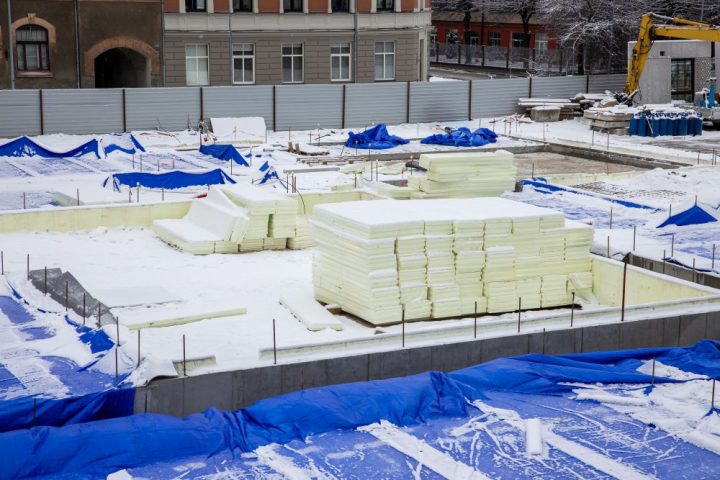
Use Cases on a Formwork and Concrete Job Site
Protecting Assembled Formwork Before Unexpected Rain
Formwork assembled at the end of the day is often left in place overnight, waiting for inspection or for the pour itself. A tarp stretched over the assembly keeps the wood from swelling, prevents the rebar from rusting prematurely, and stops a puddle from forming at the bottom of the formwork before the concrete is poured.
Containing Dust During Form Stripping and Grinding
Sawing, jackhammering, grinding, and sanding concrete produce fine dust that needs to be contained at the source. A tarp stretched as a screen around the work area or laid on the ground captures some of this residue and limits its spread onto adjacent surfaces that have already been finished.
Covering Elevated Formwork or a Slab
On an elevated slab, a bridge deck, or formwork installed on scaffolding, the risk is no longer just rain or dust: it’s material falling to lower levels or to the ground. This is the use case where debris netting applies, not solid tarps, which aren’t designed for this kind of elevated containment.
Blocking Wind and Retaining Ambient Heat in Cold Weather
Mortar and concrete need heat to set properly. A woven polyethylene tarp stretched over a recently poured structure, combined with a heat source, retains ambient heat and blocks the wind—two factors that help maintain minimum hydration conditions in cold weather. This is not a certified insulating product with an R-value: it’s a protective tarp used in combination with a heat source, just as on other masonry and concrete job sites in Quebec.
Which Tarp to Choose for Your Formwork Project
850-Denier Woven Polyethylene Tarp
Made from woven high-density polyethylene at 8 threads × 8 threads per square inch, this tarp is suitable for covering formwork before a pour and for protection against rain. Good value for everyday use on a concrete job site.
Ultra-Durable 6-Ounce Tarp
Recommended for heavy form stripping, grinding, and high-volume concrete job sites. Its heavier weight absorbs impacts and repeated friction without tearing, unlike a lighter tarp pushed beyond what it can handle.
Debris Netting
Made from braided polyethylene mesh and manufactured in Quebec, these nets are used for elevated formwork and slabs where there’s a risk of falling material: multi-level parking structures, bridge decks, and slabs poured in stages at height.
| Product | Recommended Use | Not Suitable For |
| 850-denier | Covering formwork before a pour, everyday rain protection | Heavy form stripping, intensive grinding |
| 6-ounce | Heavy form stripping, grinding, high-volume concrete job sites | Elevated containment |
| Debris netting | Elevated formwork and slabs, multi-level structures | Ground covering, rain protection |
Why Job Site Protection Matters for a Concrete Contractor
Formwork left uncovered before rain can delay a pour by several days while the wood dries out or the reinforcement is rechecked. Once the concrete is poured, stripping the forms and grinding surfaces produces a significant amount of fine dust that needs to be controlled—not only to keep the job site clean, but because Quebec regulations require it for certain activities.
Using a construction tarp, especially one that’s well chosen, addresses both problems at once: it protects the formwork upstream and contains residue downstream, without slowing down the crew’s pace.
Why Choose Toiles GR
Toiles GR is a Quebec manufacturer of custom tarps and covers with more than 30 years of experience. The materials we use are selected primarily from North American sources, to withstand the repeated demands of a concrete job site—not just to hold up for a single season. When you call, you speak to someone who knows the difference between an 850-denier tarp and a 6-ounce tarp in a real job site context, not a general distributor between two hardware store aisles.
A Tarp Suited to Your Concrete Job Site
The right weight and size depend on the type of work, the length of the job, and the level of exposure. Contact our experts in custom tarp and cover manufacturing for a recommendation suited to your formwork or concrete job site. You can also explore our full range of construction tarps and covers.
FAQ: Tarps and Job Site Protection for Formwork Carpenters and Concrete Workers
1. Which tarp best protects formwork before the concrete pour?
The 850-denier woven polyethylene tarp is suitable for most formwork-covering situations before a pour. It protects against rain and everyday weather at a good price-to-performance ratio.
2. How can concrete dust be limited during form stripping?
A tarp stretched as a screen around the sawing or grinding area, or laid on the ground, captures some of the residue. For sawing, breaking, and grinding concrete, the CNESST has required specific containment measures since 2023.
3. Can a construction tarp replace an insulating cover for concrete?
No. A construction tarp has no R-value or certified insulating core. Combined with a heat source, a woven polyethylene tarp retains ambient heat and blocks the wind, but it does not replace a certified insulating product specifically designed for curing concrete in cold weather.
4. What product should be used for elevated formwork or a slab?
Debris netting is designed for this role: elevated formwork, raised slabs, and multi-level structures where there’s a risk of falling material. A solid tarp is not suited to this kind of elevated containment.
5. Are Toiles GR tarps reusable across multiple job sites?
Yes, provided they’re folded correctly after use and stored away from UV exposure. A well-maintained 6-ounce tarp can be used across several consecutive job sites.
6. What weight should be chosen for a high-volume concrete job site?
The 6-ounce tarp is recommended for heavy form stripping and intensive grinding. Its heavier weight absorbs repeated impacts without tearing on the edges of the formwork.
7. Does the CNESST require dust containment for all formwork work?
No, only for specific activities likely to generate crystalline silica dust: sawing, jackhammering, grinding, sanding, and drilling concrete. Consult the CNESST page on crystalline silica for the complete list of required measures.