


Demolition Tarps : Site Protection for Professionals
On a demolition site, a tarp is not a last-minute accessory. It is a central component of the protective system. It contains dust, contains debris, isolates active areas, and protects adjacent structures. A poorly chosen tarp tears at the first blow of a jackhammer, lets silica dust through, and exposes your site to real risks.
At Toiles GR, we manufacture and distribute construction tarps designed for the real-world conditions of Quebec job sites. Durability, appropriate weight, and large sizes: our products meet the requirements of demolition contractors, project managers, and their teams.
What you’ll find at Toiles GR:
- Durable tarps to contain dust and demolition debris
- Standard and custom sizes for all types of construction sites
- Materials selected for repeated heavy-duty use
- A Quebec-based manufacturer that understands the realities of the field
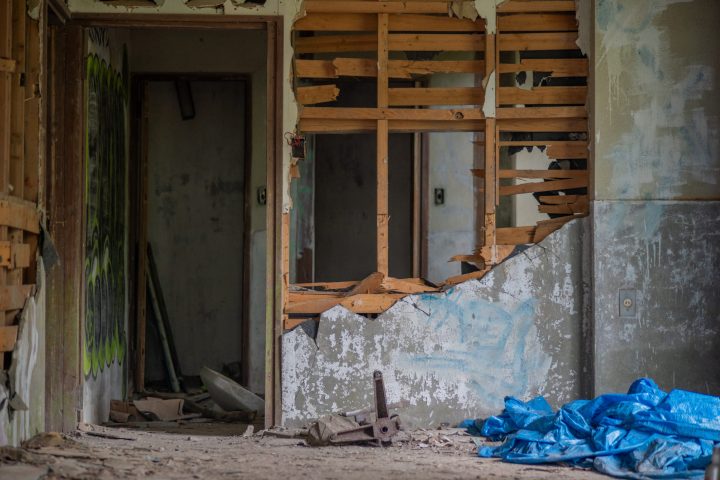
Common Uses for Tarps on a Demolition Site
Demolition work encompasses a wide variety of situations. Here are the scenarios in which a sturdy tarp becomes essential.
1. Dust Containment During Interior Demolition
Demolishing a partition, floor, or ceiling generates a considerable amount of fine dust. Stretched vertically over a temporary frame or secured to the ceiling and walls with sealing tape, the tarp creates a barrier that limits the spread of dust into adjacent spaces that are still occupied or under construction.
This containment is particularly critical in partially occupied commercial buildings, residential renovations where occupants remain in the home, and apartment building renovations.
2. Protection of adjacent structures during partial demolition
When demolishing one section of a building while leaving another part intact, the tarp protects walls, floors, and openings that are not in the demolition zone. It limits collateral damage caused by flying debris and accumulated dust.
3. Thermal Insulation and Weather Protection
On outdoor construction sites, a partially demolished structure is often exposed to the elements. A sturdy construction tarp protects open areas between work shifts, preventing rain, snow, or frost from compromising the condition of the building or stored materials.
4. Debris containment and neighborhood protection
During demolitions involving multiple levels, protecting lower areas from falling debris is a regulatory requirement in Quebec. Sturdy tarps secured to temporary structures or scaffolding serve as a containment net for flying debris.
The CNESST specifies that it is prohibited to perform work simultaneously in stacked areas unless the lower levels are protected against falling materials. The containment tarp directly meets this requirement.
5. Protection of Stored Materials and Equipment
On a demolition site, salvaged equipment, tools, and materials often need to remain on-site between work sessions. A tarp placed over these storage areas protects them from dust, debris, and inclement weather, reducing losses and delays.
6. Demarcation of work zones and access signage
Combined with posts or a lightweight structure, the construction tarp serves as a temporary fence. It visually demarcates active zones, prevents unauthorized access, and signals hazardous areas. A quick-to-install solution requiring no permanent infrastructure, it adapts to the daily changes on the job site.
7. Ground Cover During Selective Demolition
Selective demolition involves sorting and recovering materials. Tarps laid on the ground protect recovered materials (wood, metal, ceramics) from contaminants, moisture, and impact during sorting. They also facilitate post-work cleanup.
8. Protection During Facade Demolition and Work at Height
Facade demolition work exposes areas below to flying debris. A tarp secured to the scaffolding contains the debris and protects pedestrians, vehicles, and ground-level facilities. It helps ensure regulatory compliance on urban construction sites.
Our Construction Tarps for Demolition Projects
Requirements vary depending on the intensity of the work, the duration of exposure, and the type of materials being demolished. Here are the options available from Toiles GR.
Woven polyethylene tarps: great value for everyday use
Made from high-density polyethylene woven at 8 × 8 threads per square inch (850 denier), with a waterproof coating on one side. Lightweight, quick to set up, and easy to cut to size. The edges are reinforced with a cord integrated into the hem. Metal grommets are spaced every 3 or 4 feet, with a cord attached to each anchor point.
Features:
- Resistant to moisture and light splashes
- Good UV resistance over short to medium periods
- High tensile strength
- Standard sizes available: 15′ × 20′, 20′ × 30′, 30′ × 50′
- 15′ × 755′ rolls for custom cutting
These tarps are suitable for short-term demolition sites, light containment, and temporary protection of materials.
3.5-ounce white tarps: for medium-term construction sites
Thick enough to absorb splashes without letting fine dust through, they fold easily and withstand multiple uses. The FR (flame-retardant) version is recommended for buildings subject to fire safety requirements, such as residential or commercial buildings undergoing renovation.
6-ounce ultra-heavy-duty tarps: for intensive demolition work
For job sites exposed to heavy debris, repeated abrasion, or prolonged exposure. The 6-ounce weight offers maximum resistance to mechanical stress. These tarps are available in green or white. They are designed to last an entire season, not just a single job.
Recommended for mechanical demolition, facades, concrete work, and high-rise construction sites.
Why Demolition Work Requires a Dedicated Tarpaulin
Demolition work creates stresses that most generic tarpaulins are not designed to withstand. Concrete dust, flying brick fragments, material splatter, and the mechanical stress from falling debris quickly put undimensioned fabric to the test.
In Quebec, the CNESST specifically regulates demolition work and requires employers and project managers to cordon off work zones and control access. A tarp is one of the primary containment tools for meeting these requirements.
A well-chosen tarp does more than just keep a job site clean. It protects your workers’ health and helps you comply with your legal obligations.
What Sets Our Demolition Tarps Apart
Resistance to UV Rays and Quebec’s Weather Conditions
A demolition project often lasts several weeks. A tarp exposed to the Quebec sun without UV protection quickly becomes brittle, loses its tension, and eventually tears. Our tarps are treated to last, whether in the summer heat or sub-freezing winter temperatures.
Sturdy grommets and reinforced edges
This is often where cheap tarps fail: the grommets rip out and the edges fray. On a demolition site where fasteners are subjected to equipment vibrations, a tarp whose anchor points fail becomes unusable within a few days. The reinforced edges and metal grommets on our products withstand this stress without giving way.
Large Formats and Cut-to-Size Rolls
The areas that need to be covered on a demolition site rarely fit standard dimensions. That’s why we offer sizes up to 30′ × 50′ and rolls measuring 15′ × 755′ to create covers tailored to each layout without unnecessary waste.
Volume availability for contractors
Our tarps are available in bundles of 5 or 10 sheets, depending on the size. For a contractor working on multiple sites simultaneously, maintaining an available stock prevents the need for rush orders between work phases.
Why Choose Toiles GR for Your Demolition Tarps
Toiles GR has been a manufacturer specializing in industrial tarps and fabrics for over 30 years in Quebec and across Canada. We are not a general distributor selling tarps between rows of hardware. When you call, you speak to someone who knows the difference between an indoor demolition tarp and a facade tarp, and who can guide you to the right product the first time.
- Manufacturing and distribution in Quebec: products designed for local climate conditions
- North American-sourced materials: high-density polyethylene selected for heavy-duty use
- Wide range in stock: standard sizes available for fast delivery
- Volume orders: pricing tailored to contractors working on multiple projects
Protect Your Construction Sites with the Right Demolition Tarpaulin
Using a tarpaulin on a construction site is a technical decision, not a default purchase. On a demolition site, an undersized tarpaulin costs more in the long run than one that’s chosen correctly from the start: time wasted replacing it, regulatory risks, and damage to adjacent surfaces and structures.
At Toiles GR, we don’t sell generic tarps and hope they’ll work. We manufacture and distribute products specifically selected to meet the needs of construction professionals in Quebec. Whether you’re looking for an affordable tarp for a one-time demolition job or an ultra-durable tarp for a full season of construction work, our team can guide you.
Contact our experts in custom tarp and canvas manufacturing for a recommendation tailored to your project.
Frequently Asked Questions About Demolition Tarps
1. What tarp thickness should I choose for a demolition site?
The choice of weight depends on the intensity of the work. For light demolition (partitions, drop ceilings, finishing work), a 3.5-ounce tarp or standard polyethylene tarp is suitable. For heavy demolition involving concrete, brick, or mechanical work, 6-ounce tarps provide the necessary resistance to projectiles and repeated friction.
2. Can a construction tarp be used to contain silica dust?
Yes, provided it is used correctly. A tarp stretched over a frame or sealed to the walls with tape helps limit the spread of dust. The CNESST specifies that containing the source of dust emissions is a recognized control measure for work involving exposure to crystalline silica. It must be combined with other measures: source extraction, humidification, and respiratory protection.
3. How do you secure a tarp at a demolition site?
Reinforced grommets allow the tarp to be secured to posts, temporary structures, or scaffolding rails. For vertical containment (partitioning or zoning), a tarp stretched over a lightweight wooden or aluminum frame using straps or ropes threaded through the grommets ensures good stability. For ground cover, weighted edges or edges secured with sealing tape prevent the tarp from shifting under the weight of equipment.
4. Are your tarps available in large sizes for industrial demolition sites?
Yes. Our construction tarps are available in 30′ × 50′ pre-packaged sizes, and in 15′ × 755′ rolls for projects requiring custom coverage. For non-standard sites, we also manufacture custom tarps to the exact dimensions required.
5. Can a tarp be reused from one demolition site to another?
Yes, provided it is inspected after each use. 6-ounce tarps are designed to last through several consecutive projects if they are cleaned, dried, and stored properly. Standard polyethylene tarps are also suitable for reuse over short to medium periods, depending on the level of exposure.
6. Do you offer bulk pricing for demolition contractors?
Yes. Our bundles of 5 or 10 tarps help reduce the unit cost and maintain an operational stock on-site. For large orders or regular needs, contact us directly to discuss the best terms based on your volume.